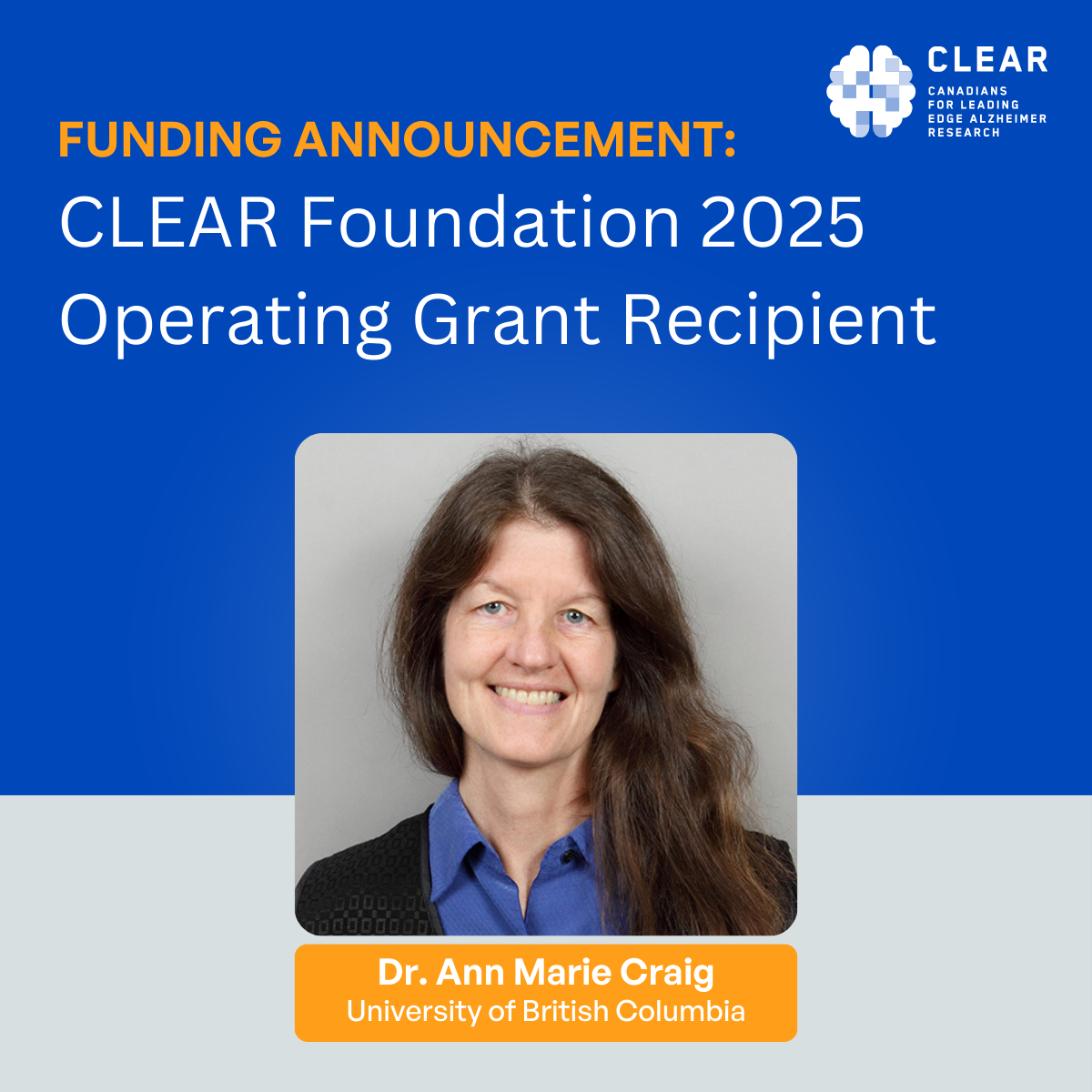

Announcing CLEAR Foundation's 2025 Operating Grant Recipient, Dr. Ann Marie Craig
December 17, 2025
Funding the next step forward in dementia research
CLEAR Foundation is honoured to announce Dr. Ann Marie Craig, Professor of Psychiatry at UBC’s Djavad Mowafaghian Centre for Brain Health, as our 2025 Operating Grant Recipient.
Dr. Craig's research project entitled, "Targeting Synapses in Alzheimer's Dementia and Lewy Body Dementia" will focus on one of the earliest and most critical changes that occur with memory loss disease: the disruption of synapses (known as the tiny connections that allow brain cells to communicate with one another).
Her work aims to uncover how these connections are affected in Alzheimer’s disease and Lewy body dementia, two of the most common forms of dementia.
Why synapses matter
The human brain utilizes billions of synapses that transmit signals responsible for memory, movement, thinking and behaviour. Long before brain cells die, these connections begin to weaken or disappear, and this loss is closely linked to cognitive decline.
Researchers believe synapse damage may be one of the earliest causes of memory loss, yet studying these tiny structures in the human brain has historically been extremely difficult, due to technical limitations.
Dr. Craig's research will address this challenge directly.
A new way of seeing the brain
Using cutting-edge imaging techniques, Dr. Craig and her collaborators will examine postmortem human brain tissue from individuals with Alzheimer’s disease, Lewy body dementia, and older adults without dementia.
Her team will combine two advanced methods:
-
Expansion microscopy, which physically expands brain tissue so microscopic structures can be seen in much greater detail. (This not only improves the effective resolution through the physical expansion, but also improves the labelling via increased access of antibody probes to the synaptic proteins). Many synaptic proteins cannot even be labelled by standard methods.
-
Lattice light-sheet microscopy, which allows researchers to image large areas of tissue quickly and with exceptional resolution.
Together, these tools will allow the visualization of synapses in ways that were not previously possible, effectively revealing how dementia-related proteins interact with and damage the brain’s communication networks.
Why this matters for people living with dementia
By identifying which synaptic components are most vulnerable (and most closely linked to memory loss) Dr. Craig's research will lay critical groundwork for future advancements in treatment.
Understanding where and how synapses fail in the human brain is a necessary first step towards developing therapies that could one day protect or restore these connections, potentially slowing or preventing cognitive decline.
This human-focused approach reflects CLEAR Foundation’s commitment to supporting research that brings us closer to valuable, real-world impact for individuals and families affected by dementia.
From discovery to breakthroughs
CLEAR looks forward to sharing research updates on Dr. Craig's critical work.
Through ongoing donor support, we are proud to help advance scientific discovery that deepens our understanding of all forms of dementia, moving us closer to meaningful breakthroughs for individuals, families and communities affected by these diseases.